


Find Em All! - Hidden Objects
Agave Games
I picked up Find Em All! - Hidden Objects expecting a simple way to fill a few spare minutes, and that is exactly where it makes the strongest first impression. This is a free puzzle game from Agave Games built around the familiar pleasure of scanning a busy picture and spotting what does not immediately stand out. Its store summary, “Find Every Hidden Object,” describes the basic idea accurately, but the real appeal is the speed of that first interaction: there is very little to learn before you are already looking.
That simplicity matters. I do not need to remember a complicated rule set, build a team, manage resources, or prepare for a long campaign. I can open it, focus on a visual scene, make progress, and put it down when something else needs my attention. The game is rated for Everyone, which fits its approachable presentation and straightforward puzzle premise. At the same time, its easy entry does not automatically make every session equally satisfying. The more important question is whether finding objects remains enjoyable after the novelty fades.
Why the first few puzzles are so easy to start
The opening experience is appealing because the central task is immediately readable. I know I am looking for hidden items, and the screen gives me a clear visual problem rather than a long explanation. That makes the game suitable for the kind of short break where I want a small mental activity but do not want to spend the first few minutes learning controls.
This is also where the game differs from many puzzle alternatives. A match-three title usually asks me to think in terms of patterns and future moves. A word game depends on vocabulary and recall. A logic puzzle can require sustained concentration across several steps. Here, the main skill is visual attention: scanning, comparing shapes, noticing color changes, and resisting the urge to tap randomly.
I found that distinction useful in everyday situations. If I am waiting for an appointment or sitting on public transport, a hidden-object puzzle gives me something active to do without demanding that I remember a complicated position after an interruption. It occupies my attention, but it does not feel like a commitment to a long play session.
Related News






The best early moments come when an item is technically visible but visually disguised by nearby details. I may pass over it once, then notice a small outline or an unusual color relationship on the second look. That creates a modest but genuine “there it is” feeling. It is not the dramatic satisfaction of solving a difficult logic problem, but it is immediate and accessible.
A useful way to approach each scene
My most reliable method is to divide the image into sections instead of sweeping my eyes randomly. I start at one corner, move across in a steady line, and then work downward. This reduces the chance of repeatedly checking the same busy area while overlooking the opposite side. It also turns a vague search into a manageable routine.
When an object is difficult to spot, I avoid tapping everywhere. Random tapping can make the experience feel less like observation and more like guessing. I pause, compare repeated shapes, and look for an item that breaks the scene’s visual rhythm. That small change in approach is one of the more useful lessons the game encourages: careful attention is usually more rewarding than frantic input.
Gallery
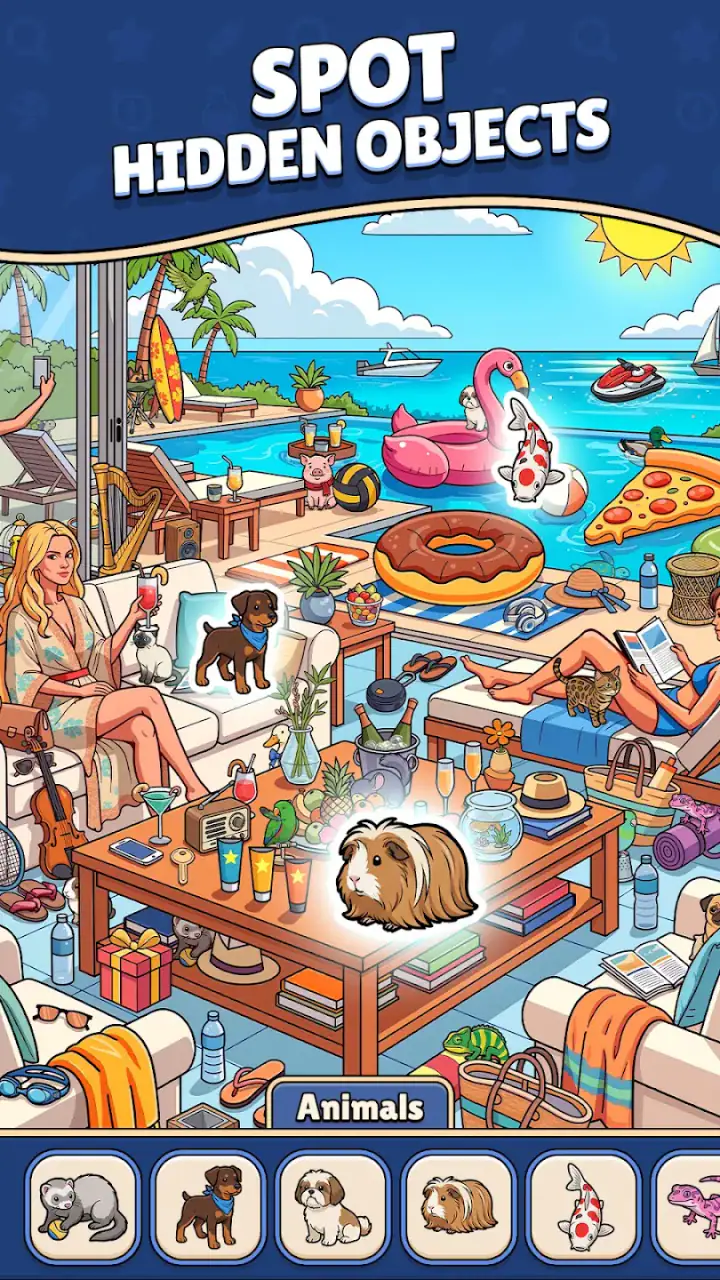
Players who enjoy visual puzzles will understand the appeal quickly. Players who prefer a clear answer after every move may find the format less compelling, because the challenge comes from uncertainty rather than from a visible chain of correct decisions. There is no single clever trick that solves every scene. The quality of the experience depends heavily on how thoughtfully the hidden objects are placed.
How it fits into a short break
The game works particularly well when I have only a few minutes and want something more engaging than scrolling. I can begin without setting aside a full evening, and the basic objective remains understandable even if I have not played for a while. That makes it friendlier to irregular players than puzzle games that punish gaps in attention or require a detailed memory of previous systems.
A realistic example is a short lunch break. I might open a scene while waiting for food, search carefully for a while, and stop when the break ends. The activity has enough focus to feel like play, but not so much narrative dependence that leaving halfway makes me lose the thread of the experience. For me, that low commitment is one of its clearest strengths.
There is a trade-off, though. A short-session game needs to make each small session feel complete. If a scene becomes visually noisy without offering a satisfying discovery, the same convenience can turn into mild frustration. The game is at its best when the challenge makes me look more carefully, not when it simply makes me tap longer.
Returning after an interruption
One of the strongest qualities of this type of puzzle is its tolerance for interruption. If I have to answer a message, move to another task, or close the game unexpectedly, I can usually return to the basic activity without reconstructing a complicated plan. That is a major advantage over strategy and narrative games, where even a short break can make the next step feel unclear.
I would choose this game over a more demanding alternative when my attention is divided. It is a better fit for a waiting room than a puzzle that requires several moves to be planned in advance. It also suits players who want a calm visual exercise rather than a competitive timer-driven experience. The moment-to-moment goal stays stable, so returning does not feel like homework.
That does not mean every interruption is harmless. If I leave a scene while I am mentally tracking several similar objects, I may need to rescan the area when I come back. The game’s simplicity helps, but it cannot preserve a visual impression that has already faded. My practical tip is to finish a small search area before switching away, rather than stopping in the middle of a dense cluster.
This is also where screen size can influence comfort. On a larger display, small objects and crowded details are easier to inspect. On a smaller phone, I need to pay closer attention and may spend more time distinguishing an item from its background. That is not a flaw unique to this title, but it matters because the entire challenge depends on seeing details clearly.
Who will appreciate the low-commitment design
I think the game is a good match for casual players, families looking for an uncomplicated puzzle, and anyone who enjoys visual searching without pressure from complex rules. Its Everyone age rating reinforces that broad accessibility. It can also work for experienced puzzle fans who want a change of pace between more demanding games.
I would be more cautious recommending it to people who need constant novelty, deep progression, or a strong competitive layer. A hidden-object game can provide a pleasant burst of concentration, but it is not automatically a substitute for a rich adventure, a long-form brain teaser, or a game built around mastery of advanced mechanics.
It is also not the best choice if I want every session to feel dramatically different. The basic pleasure is deliberately narrow: inspect, notice, select, and continue. That focus is what makes it easy to return to, but it is also what may limit its appeal for players who quickly tire of repeated visual searching.
Where replay value comes from—and where it may weaken
The replay value depends less on a complex system and more on the quality of the scenes and my own tolerance for repetition. A well-designed hidden-object image can remain interesting because I do not notice everything on the first pass. Returning to a familiar style of puzzle can still feel satisfying when the search is fair and the objects are integrated naturally into the artwork.
However, the basic action does not transform itself into a different genre over time. I am still searching for concealed items, so players who expect new mechanics at every stage should keep their expectations modest. The game’s appeal is closer to a collection of small visual challenges than to a journey with major structural changes.
One way I keep the experience fresher is to change my goal. Sometimes I play for speed, while at other times I focus on accuracy and try to understand why an object was easy or difficult to notice. I also find it more enjoyable to stop after a satisfying discovery instead of continuing until the activity feels repetitive. Because the sessions are naturally compact, ending at the right moment helps preserve the pleasure of returning later.
This is an important trade-off compared with other puzzle categories. A word game may expand my vocabulary, and a logic game may teach me a reusable solving technique. A hidden-object game primarily trains patience and visual scanning. Those are useful skills, but the reward is more immediate and sensory than cumulative. I play it for the feeling of noticing, not because I expect a deep progression of knowledge.
What to expect from the free model
The game is free to download, which makes it easy to try without making a financial commitment at the start. It includes in-app purchases priced at $8.99 per item. For me, that means the sensible approach is to play enough to decide whether the core search loop is enjoyable before considering any purchase.
The purchase structure is worth thinking about in terms of personal habits. If I am happy with occasional short sessions, the free entry is attractive. If I tend to spend money to remove every moment of difficulty or to keep moving when patience runs out, I should set a limit before playing. A hidden-object game works best when I allow myself to look carefully rather than treating every delay as something to bypass.
I also would not judge the game solely by the existence of optional purchases. The more relevant question is whether the unpaid play already gives me a reason to return. In my view, this kind of title needs to earn that return through fair visual challenges and comfortable pacing, not through pressure. Players who dislike any purchase prompts in free games may prefer a paid puzzle with a simpler ownership model.
How it compares with familiar puzzle alternatives
Against match-three games, this title feels quieter and less reflexive. I am not chasing combinations or reacting to a board that changes after every move. That makes it better for relaxed observation, but less exciting for players who enjoy cascading effects and quick decisions.
Against crossword and word-search games, it removes the need for language knowledge. That broadens its accessibility and makes it easier to play when I am tired. The downside is that it offers less opportunity to exercise spelling, vocabulary, or verbal deduction.
Against traditional logic puzzles, it asks for a different kind of concentration. I am not building a proof or testing a sequence of deductions. I am training my eyes to separate foreground from background and to recognize details in a crowded composition. If I want a measurable intellectual challenge, a logic title may be more rewarding. If I want a direct visual task that I can understand instantly, this game has the advantage.
Compared with a narrative adventure, it is far easier to pause and resume, but it offers less emotional context. There are no story developments I need to remember in order to appreciate the next session. That makes it practical for fragmented time, although players who need characters and plot to stay engaged may find the experience too bare.
Performance expectations and version context
The current version is 1.0.7, and the listed minimum operating system is version 10. That makes checking device compatibility a sensible step before installing, especially on an older phone or tablet. The game’s visual focus also means that display clarity matters more than it would in a text-heavy puzzle.
Agave Games has positioned the title in the puzzle space rather than as a broader action or adventure release. Its store presence shows a 5.0 average from around ten thousand ratings, with more than one hundred thousand installs. Those figures suggest that the straightforward concept has found an audience, although they do not replace my own test of whether the search loop suits my patience.
I would treat the rating as an encouraging sign rather than a guarantee. Hidden-object games can feel very different depending on how much visual density I enjoy and how fair I find the placement of targets. A player who loves scanning detailed scenes may rate the same design more highly than someone who finds small objects tiring to locate.
My casual verdict after living with the search loop
Find Em All! - Hidden Objects succeeds because it respects the value of a short, uncomplicated session. I can understand the objective immediately, focus on one visual task, and leave without feeling that I have abandoned a complicated plan. For a quick break, that clarity is more important to me than an elaborate feature list.
Its best use case is a player who wants gentle concentration with an immediate payoff. It is especially suitable when I have uncertain time, such as waiting between errands or taking a brief pause during a busy day. The game does not demand that I reserve a large block of attention, and that makes it easier to fit into real life than many deeper puzzle alternatives.
The limitations are just as clear. The central activity can become repetitive, and replay value depends heavily on whether I continue enjoying visual searches after the initial novelty. It is not the right recommendation for someone seeking complex strategy, a strong story, competitive pressure, or a constantly changing set of mechanics. In those cases, another puzzle category will probably offer more lasting variety.
For everyone else, I think the free download is worth trying because the premise can be judged quickly and honestly: open a scene, slow down, and see whether the act of noticing feels rewarding. My advice is to search methodically, take advantage of the game’s short-session nature, and avoid turning every difficult item into a reason to rush toward a purchase. If you enjoy the small satisfaction of spotting what your eyes missed a moment earlier, this is a pleasantly accessible puzzle to keep around.
FAQs for Find Em All! - Hidden Objects
What is Find Em All! - Hidden Objects?
Find Em All! - Hidden Objects is a casual puzzle game focused on observation and visual search. Each level presents a detailed scene filled with objects, characters, or items that you must locate according to the instructions. The game is designed for short play sessions, making it suitable for relaxing at home, traveling, or taking a quick break while testing your attention to detail.
How does the gameplay work?
The main objective is to carefully examine each illustrated scene and tap the hidden objects you are asked to find. Some items may be easy to spot, while others blend into the background through similar colors, small sizes, or clever placement. Progress generally depends on finding the required objects, so patience and a systematic search are more useful than simply tapping randomly across the screen.
Is Find Em All! - Hidden Objects suitable for children?
The game can be appropriate for children who enjoy simple visual puzzles, although suitability may depend on the child’s age, reading ability, and tolerance for advertisements or timed challenges. The hidden-object format is generally easy to understand, but parents should review the app’s store listing, content rating, advertising behavior, and any available purchase options before allowing unsupervised play.
Does the game require an internet connection?
Basic hidden-object gameplay may be available without a constant internet connection, depending on how the installed version handles level downloads, advertisements, updates, and optional features. However, some functions may require connectivity, particularly video hints, promotional content, cloud-related services, or in-app purchases. It is best to test the game in offline mode before relying on it during travel.
Are there advertisements or in-app purchases?
Like many free-to-download casual puzzle games, Find Em All! - Hidden Objects may include advertising and could offer optional purchases, such as removing ads, unlocking content, or obtaining hints. The exact options can vary by platform and app version. Before downloading, check the current Google Play or App Store listing, and review purchase settings if children will be using the device.
Pros
- Simple controls make it easy for beginners to start playing.
- Short levels are convenient for quick sessions on the go.
- Hidden-object scenes offer a relaxing
- low-pressure experience.
- Bright artwork makes important details easier to spot.
- Progression encourages players to improve their observation skills.
Cons
- Some scenes may feel repetitive after extended play.
- Small objects can be difficult to identify on smaller screens.
- Timed challenges may frustrate players who prefer a slower pace.
- Hints or extra attempts may be limited during difficult levels.
- The game may offer less variety for experienced puzzle players.


